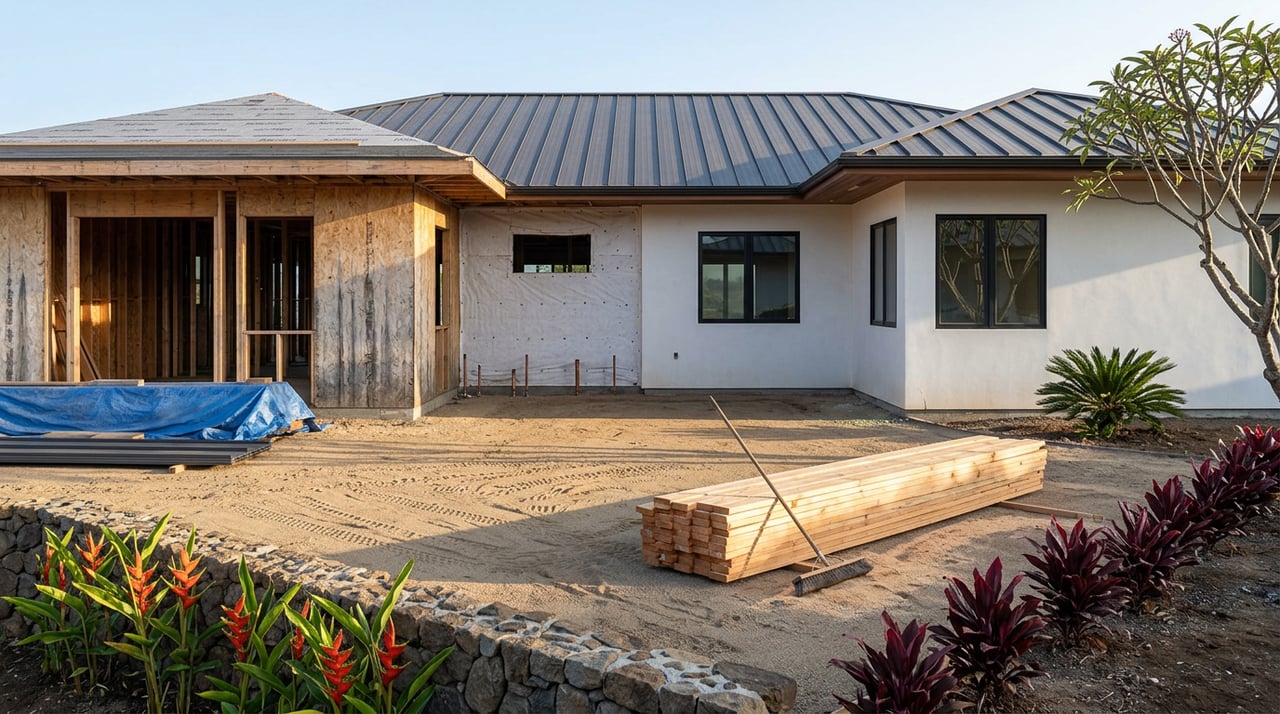
Ask Maui County how the Lahaina rebuild is going three years after the fire and the answer is that 81.9 percent of the 2,746 housing units lost are now on a path to rebuild, with the county issuing or processing permits for roughly another 1,264 units on top of the nearly 600 homes already occupied. Ask an independent analysis of the same county permit data and you get a very different number: fewer than 25 percent of the 926 disaster recovery permits filed for residential rebuilding had actually been completed as of July 15, 2026, and fewer than 6 percent of non-residential permits had.
Both numbers are true. They are measuring different things. If you are looking at a lot or a new-construction listing in Lahaina right now, knowing which measurement applies to that specific parcel matters more than the headline percentage, because it is the difference between a project that finishes next year and one still working through public hearings in 2028.
Three stages hiding inside one percentage
The county's recovery dashboard tracks properties through distinct stages: application submitted, permit issued, and permit completed, meaning the home has passed final inspection and is ready for habitation. The 81.9 percent figure county officials cite counts a property as "on a path" the moment an application is filed. That is a meaningful milestone, but it is not the same as a finished house.
When AsAmNews pulled the underlying Maui County permit records through July 15, 2026, the completed count told a slower story: under a quarter of residential disaster recovery permits done, under 6 percent of non-residential ones. A separate late-July dashboard snapshot cited by local reporting put it at 339 Lahaina permits still in process, 562 issued, and 246 completed, numbers that land in roughly the same range once you account for the few days between snapshots.
Neither set of numbers is wrong. The gap between them is the actual thing a buyer needs to understand before pricing a parcel.
What that gap looks like on Front Street
Front Street reopened to vehicle traffic between Pāpalaua and Shaw streets on August 1, 2026, along with Dickenson and Prison streets, while Market Street, Papelekane Street, and Mokuhinia Place stayed closed. That is genuine, visible progress. It is also true, according to Civil Beat's three-year anniversary reporting, that none of the businesses destroyed along Front Street had been rebuilt as of that same week. The historic commercial core is still largely graded gravel lots even as the road around it reopens.
The named projects illustrate why. 612 Front Street, which once housed the Pacific Whale Foundation, Maui Hands Art Gallery, Andrew Shoemaker Fine Art Photography, and a foil boarding rental kiosk, is expected to be the first Front Street commercial building permit issued, but only after the State Historic Preservation Division spent close to a year satisfied on an archaeological inventory survey that wasn't cleared until June 2026. 764 Front Street has faced a similar holdup. The Fleetwood building, the only structure left standing on the 700 block, is partway through a $12 million restoration, and even a partially intact shell turned out to complicate permitting rather than simplify it.
Grassroot Institute analyst Jonathan Helton went a step further after the county's July 1 meeting, digging into the two commercial permits officials had highlighted as proof of momentum. One was a completed permit for a gas station that turned out to cover only site work and a concrete pad, not the station itself. The other was an issued permit for a Taco Bell that qualified for an expedited process because the building had been constructed new in 2022, letting it reuse plans approved within five years of the fire under a 2024 county ordinance. Helton said the framing "was news to me" once he checked the underlying records. Most other commercial buildings destroyed in the fire were decades old and don't qualify for that shortcut.
The cost of every extra day in the queue
Delay has a dollar figure attached to it. Per the state's own research, cited by Helton, each day a permit sits awaiting approval can add $100 to $200 in construction costs to a project. A parcel that needs an archaeological survey, like 612 or 764 Front Street, can carry that cost for a year or more before a shovel ever goes in the ground. A parcel that qualifies for the 2024 reuse ordinance, or that sits outside the Special Management Area entirely, skips most of that exposure.
Geography plays a role too. Rebuilds are moving faster on the mauka, or inland, side of Honoapiilani Highway than on the makai side closer to the shoreline, where the additional Special Management Area review and, in some cases, known concentrations of iwi kūpuna add rounds of public hearings that oceanfront-adjacent parcels elsewhere on the highway don't face.
What the timeline gap does to land pricing
Much of the land selling in Lahaina through 2025 was driven by insurance settlements rather than land economics. Owners who received full replacement cost payouts on structures with a low original land basis priced parcels to reflect those proceeds, not necessarily what the bare land would fetch on its own merits. Earlier this year, that pattern showed up clearly in the Lahainaluna area, where pricing and time on market varied widely and parcels priced ahead of what buyers would tolerate sat on the market longer before selling.
Earlier this year, a beachfront lot on Kai Pali Place sold for $2.6 million, one of the only land sales recorded in that stretch of Lahaina at the time. That kind of waterfront pricing, generally in the $1.5 million to $2 million-plus range for Lahaina oceanfront land, sits well above comparable non-waterfront parcels in neighboring Kaanapali, where existing entitlements and no contamination remediation requirement put land in the $800,000 to $1.2 million range. For a buyer comparing the two, the Kaanapali premium buys a faster, cleaner path to a permit. The Lahaina premium buys proximity and history, plus a longer and less predictable runway.
Puamana offers a useful real-world timeline anchor. One of the first buildings there to receive rebuild permits, 21 Puapake, was slated to begin construction in May 2026 with completion expected roughly a year later. That is a permitted, moving project in one of West Maui's most established oceanfront communities, and it still lands close to four years after the fire before anyone moves back in.
The carrying costs nobody mentions until escrow
Holding a vacant Lahaina lot while permits work through the queue carries a tax penalty that's easy to miss when comparing it to land elsewhere on Maui. Destroyed structures have been assessed at land value only since the 2023-2024 tax year, but Maui County's residential land tax rate of $6.05 per $1,000 of assessed value applies only to owner-occupants. Vacant land awaiting reconstruction is taxed at the non-owner-occupant rate of $9.37 per $1,000, a real difference in annual carrying cost for anyone planning to hold before building. New construction under the county's 2024 fire-resilience code adds another $15,000 to $45,000 in permitting fees per project on top of that.
Not every empty lot will have a rebuilt neighbor
Two efforts underway will permanently reshape which Lahaina parcels ever see new construction. Maui County is moving forward with a plan to use $50 million in federal funds to buy out roughly 10 oceanfront properties outright rather than see them rebuilt. Separately, the Lahaina Community Land Trust has been acquiring parcels in the Kaluaʻehu area, using a ground-lease model that keeps land in local hands and out of the open market. Both are good outcomes for the families and the community involved, but they mean a buyer evaluating a parcel today should ask what's actually planned for the empty lots around it, not assume every gap on the map will eventually fill in with a comparable home.
Questions worth asking before you make an offer
- Is this specific parcel's permit a combined disaster recovery permit or a standard county building permit? The recovery track moves differently than a normal application.
- Does the lot sit inside the Special Management Area or the historic district? That adds Cultural Resources Commission review and possibly an archaeological survey before anything else can move.
- What does the county's Maui Recovers dashboard actually show for this parcel's stage right now, not what the seller or listing says?
- Is the asking price built around insurance proceeds the seller received, or around what the land itself is worth to build on?
A few quick answers
Does "on a path to rebuild" mean construction has started? Not necessarily. It can mean an application was submitted, a permit was issued, or the home is finished. The three stages get folded into one county-cited percentage, so ask which stage applies to any specific property before you factor a timeline into your offer.
Why do some Lahaina rebuilds move faster than others? Zoning and location inside the Special Management Area or historic district are the biggest factors, along with whether the pre-fire structure was recent enough to qualify for the county's 2024 permit-reuse ordinance.
Is now a reasonable time to buy land in Lahaina? That depends entirely on the parcel, its permit stage, and your own timeline tolerance. A construction-informed read of a specific lot's zoning, setback status, and permit history tells you far more than the district-wide percentage does.
Every one of these details, from a parcel's Special Management Area status to what an archaeological survey actually adds to a timeline, is exactly the kind of thing a construction background helps you see before you sign anything. If you're weighing a Lahaina lot, a rebuild project, or wondering what your own West Maui property is worth in this market, reach out to Lena Taberna for a grounded, parcel-specific read, or start with a free home valuation to see where you stand today.