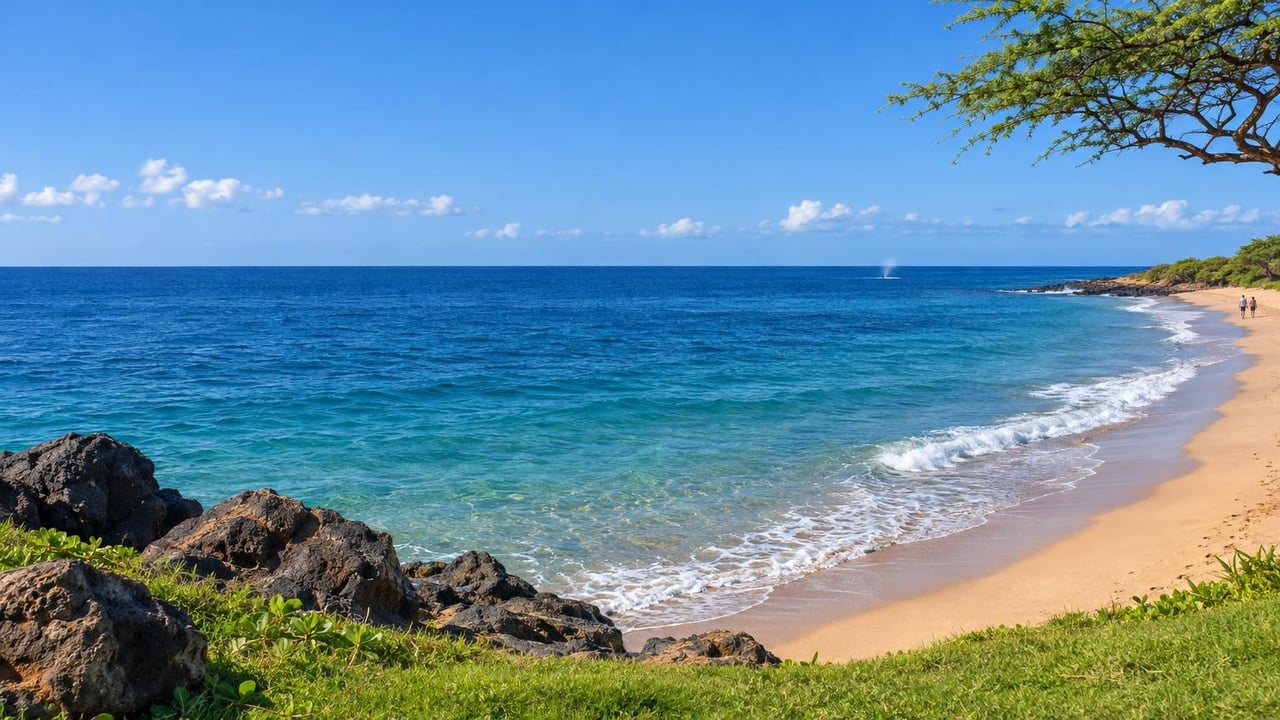
Every winter, Hawaii counts its humpback whales from the shoreline, and part of that count happens on South Kīhei Road. Volunteers stand at the Sanctuary Visitor Center and at Kihei Surfside Resort with binoculars for four hours on a winter Saturday morning. Their counts go into a record that started in 1995. That record matters more this season than in most. New research says the population is well below its peak, while the 2026 shoreline counts from Maui Nui were about the same as the year before. The whales you see from a Kamaʻole beach chair this winter are part of that story, and registration to help count them opens on December 14.
This season's first whales
According to Akakū's Maui Daily, Gemini Sailing Charters logged the first humpback sighting of the 2026–27 season on October 21, and other boaters reported more sightings after that. That is about a month later than the season before. Whale Trust told Spectrum News that its earliest report for 2025–26 was a Sea Maui Catamarans sighting on September 21, 2025. A first sighting is one boat on one day, so it says little about how many whales will come. The counts are what show that.
What the counts have been showing
In August 2026, Pacific Whale Foundation and more than 20 partner organizations published a study in Marine Mammal Science built on 21 years of photo-ID data. PWF's research summary says humpback abundance across the Main Hawaiian Islands fell by about a third, from a peak near 15,000 whales to roughly 9,900 today. The researchers trace the drop to the 2015 marine heatwave. Survival fell to 68.4% during the heatwave and has only partly climbed back toward its pre-heatwave rate of 95.6%. PWF says the heatwave likely killed many whales, and that some may have skipped the migration or moved outside the study area.
The shoreline counts tell a steadier story for the last two winters. On January 31, 2026, observers at 11 sites around Maui Nui counted 694 whales between 8:30 a.m. and noon, compared with 700 in the same count the year before. PWF chief scientist Jens Currie told The Maui News, "It's good to see there aren't any clear decreases."
| 2026 count | Area | Whales counted |
|---|---|---|
| January 31 | Maui Nui, 11 sites | 694, versus 700 in the January 2025 count |
| January | Statewide | 1,954 |
| February 28 | Off Maui | 847 |
| February 28 | Statewide | 1,935, which is 12 fewer than the February 2025 count |
| March | Statewide | 436 |
Each total is a snapshot of whales seen from shore during one morning window. Maui Now notes that the totals can include the same whale seen twice and are not population estimates. The March figure is lower because the whales are already heading north by then. NOAA's 2026 season recap says March storms may also have cut down how far counters could see from shore. So the study and the counts measure different things. The study looks at the population over two decades. The counts are a yearly reading taken from the same shoreline stations each winter.
Four Kihei shorelines with whale watching
Maui County's park pages name several Kihei beach parks for winter whale watching from shore, and each one is set up differently.
Kamaʻole Beach Park II is listed for seasonal winter whale watching, and it has no lot, so you park on the street. Kamaʻole III, a short walk south, has a grassy park where you can set up a chair and binoculars for a morning.
Toward the north end, Mai Poina ʻOe Iaʻu Beach Park is also on the county's winter whale-watching list. It has room for 10 cars by the pavilion, about 15 unmarked gravel spaces and street parking beyond that.
Keawakapu Beach Park, on the Kīhei and Wailea line, looks out toward Kahoʻolawe, Molokini and Lānaʻi. Parking is across the street on Kilohana Drive.
The Kīhei Sanctuary Visitor Center at 726 South Kīhei Road sits right on the beach, with views across sanctuary waters to Kahoʻolawe, Lānaʻi and West Maui. NOAA says humpbacks may be seen breaching from there. It is open Monday through Friday, 9:30 a.m. to 2:30 p.m.
A few practical notes apply at every one of them. Hawaii.com says early morning brings calmer water and better light for photos. Binoculars help with whales that are far out, although a column from Maui Ocean Center in The Maui News points out that you can see the whales from shore without them. The same column says snorkelers inshore can sometimes hear humpback song. It also recommends watching from beaches, parking lots and pullouts, not from behind the wheel. If you want to watch from higher up, the McGregor Point pullout on the way to Māʻalaea is popular. Hawaii.com says its lot can fill by 9 a.m. on peak-season weekends, so get there early or go on a weekday.
Kihei's two count stations
Pacific Whale Foundation's Great Whale Count turns a morning of whale watching into a data shift. PWF's 2026 site map lists the Sanctuary Visitor Center and Kihei Surfside Resort among its Maui shoreline stations. Other stations include Māʻalaea Harbor, McGregor Point and the lighthouse, Papawai Point, Polo Beach and Puʻu Olaʻi Beach. About 90 volunteers and 22 supervisors worked the January 2026 count.
The 2027 counts are scheduled for Saturday, January 30, Saturday, February 27 and Saturday, March 27. Each one runs from 8 a.m. to noon, and volunteers need to stay for the whole four hours. Registration opens December 14, 2026. Since 2019, the Great Whale Count has run on the same mornings as NOAA's Sanctuary Ocean Count on the other islands, so the whole state is counted at once, and NOAA's page points Maui volunteers to the Great Whale Count. If you already watch from South Kīhei Road, December 14 is the date to put on the calendar.
December dates around the season
Several dates fall before the first count:
- December 1, 3, 4 and 8, 10 to 11 a.m.: NOAA's "40-ton humpback whale talk" at the Kīhei Sanctuary Visitor Center, in person.
- December 5, 10:30 a.m. to 12:30 p.m.: PWF's Whale Season Kickoff Cleanup at Stable Road Beach, with online registration.
- December 14: Registration opens for the 2027 Great Whale Count.
The visitor center also posts weekly and monthly programs on NOAA's sanctuary events calendar, so check it before you go. It is an easy addition to the regular routines covered in our Kihei calendar post.
PWF calls World Whale Day one of Maui's largest community gatherings, and it last held the event at Kalama Park in 2020. After the pandemic and the Lahaina wildfires made large events hard to host, the festival returned on February 15, 2026, with a whale parade along South Kīhei Road from Kamaʻole I to Kalama Park. Kalama Park has 282 parking spaces across four lots.
The whales are already back off Maui, and I hope you catch a few good mornings at Kamaʻole II or Keawakapu. If those mornings have you thinking about a place nearer the water, or about what your own Kihei condo is worth, Lena M. Taberna can walk you through the Kihei buildings building by building. You can start any time with a free home valuation.